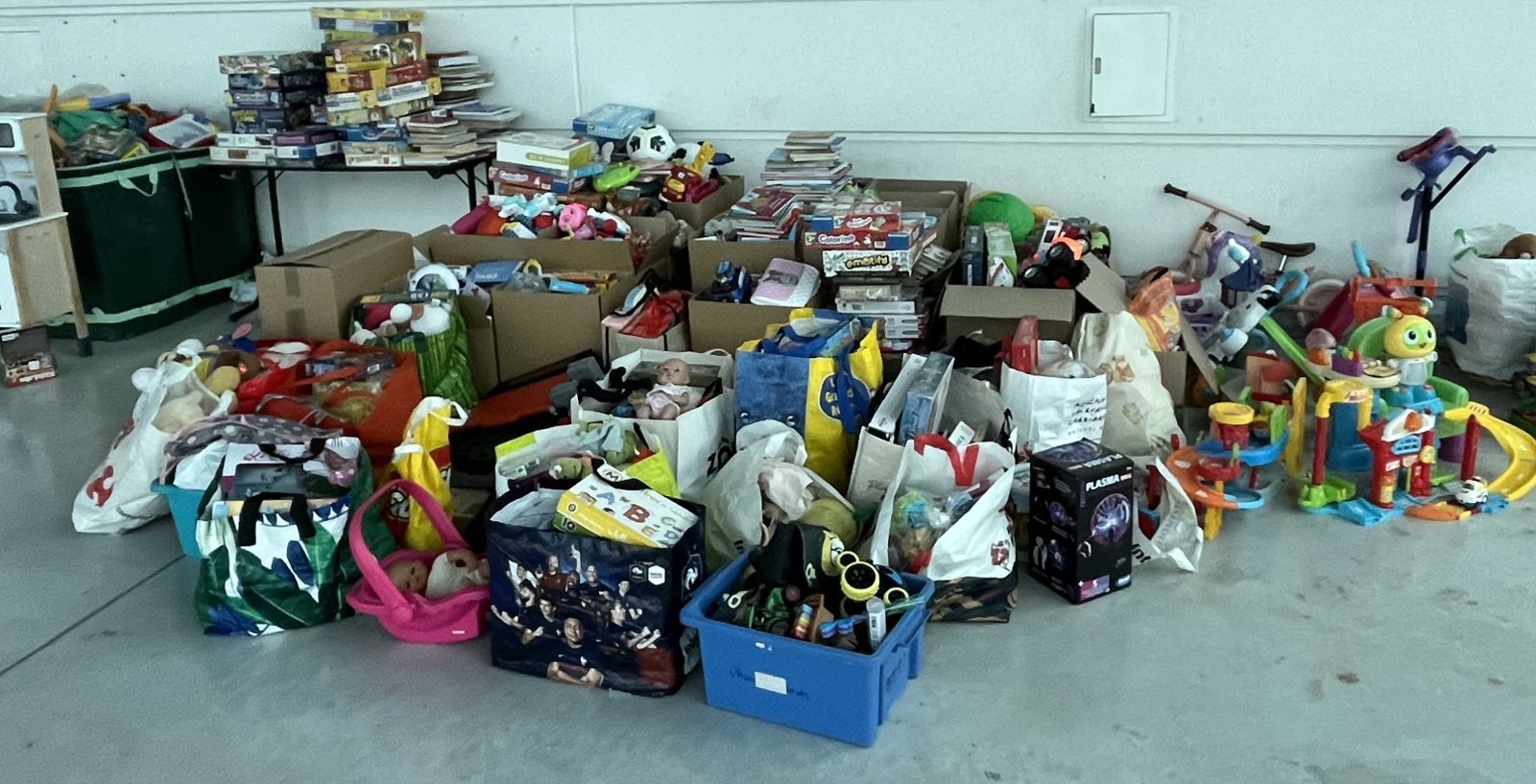
The collection drive organized at the headquarters of the Les Mousquetaires Group, with support from Ecomaison, marks the first visible step in a broader initiative. Behind this effort lies a comprehensive approach to the circular economy—structured, gradual, and collaborative. Interview with Céline Ratanavanh, Head of the Circular Economy & Climate Division.
How is the Groupement Mousquetaires’ circular economy strategy structured today?
The circular economy is one of the seven priorities of the Group’s CSR strategy. It encompasses waste reduction, collection, recycling, and reuse.
Working with Ecomaison is important because this eco-organization adapts to our specific structure as a member association and to our internal processes, which enables operational implementation.
The Group, comprising 7 brands*.How can so many retail locations be brought together around a common vision?
In France, we have over 3,000 retail locations, run by independent business owners. Our role is to make environmental regulations accessible, offer practical solutions, recommend certified service providers, and provide turnkey systems. Members are free to choose, but most follow our recommendations. We provide them with technical expertise and operational solutions that are economically viable. The challenge is always to balance environmental and economic considerations.
How exactly does waste management work at Les Mousquetaires?
We have a dedicated division, with a specific legal framework and certifications, that allows us to directly manage a large portion of our logistics operations. Our trucks that deliver goods collect waste on the return trip; we then consolidate it at our logistics hubs before reselling certain materials (cardboard, plastic film, pallets, etc.). We currently manage about twenty different types of waste. This organizational structure allows us to streamline the process for our members through service agreements that cover containers, collection, and processing.
How does the toy drive fit into this overall initiative?
We regularly organize awareness-raising initiatives at our headquarters, such as climate murals, disability awareness campaigns, training sessions, and internal events. This year, we decided to organize a toy drive among the Group’s employees, in partnership with Ecomaison’s toy recycling program. The goal was clear: to ensure that the toys were primarily donated to charities so they could be distributed to children before Christmas. The charitable aspect was a key factor in the initiative’s success.
How was this fundraiser organized and received?
We decided to make this a two-week event with a dedicated location. This is essential: a one-day collection leaves people little time to get organized, especially with remote work. With support from internal headquarters departments (communications, HR, social affairs, and CSR quality management), communication played a key role: specific posters, clear explanations of what actually happens to the toys. Knowing that they would be redistributed to children was a major motivator.
What were the results?
51
cubic meters
of toys collected, equivalent to three 17-cubic-meter trucks
The photos speak for themselves: the trucks were full. We were a bit worried at first that we’d mostly end up with toys in very poor condition. That wasn’t the case. The vast majority of the toys were in excellent condition—some were even almost brand-new, still in their boxes. Everyone really pitched in. Well done, everyone!
Can this collection campaign change the internal perception of reuse?
Yes, but it’s a process. For many people, reuse is still an abstract concept. Initiatives like this help bring it to life. More efforts like this will be needed to make these habits a lasting part of our lives.
3 Key Takeaways for a Successful Fundraiser
Setting the framework to make things easier – Ecomaison’s support helps structure the collection process and link it to an existing supply chain, without complicating the organization.
Making Giving Tangible – Clearly linking fundraising to donations for children transforms the commitment and quality of donations.
Thinking of the collection as a system – Sufficient duration, a designated location, and a clear message allow time to act and explain the scale of the mobilization.