To give a second life to ceramic products, the Communauté de Commune du Pays Fouesnantais has joined forces with four eco-organizations: Citeo, Ecomaison, Ecominero and Léko. This experiment is a first in France, and involves sorting ceramic objects and equipment
for reuse or recycling.
From now on, residents of the Communauté de Communes du Pays Fouesnantais who use the Kerambris waste collection center are invited to sort their ceramic products in the special collection bins provided.
Ceramic tableware, decorative items, packaging, sanitaryware, tiles and garden pots - there are so many different types of ceramic object. Too often thrown away in the household garbage can or the rubbish dumpster, ceramic products can now be given a second life through re-use or recycling.
An experiment is being carried out on the territory of the Communauté de Communes du Pays Fouesnantais, an innovative area in terms of the circular economy, which has volunteered to test the sorting of ceramic materials at its Kerambris waste collection center in Fouesnant. New sorting instructions have been deployed to inform users that ceramic products "intact and
in good condition" are to be deposited in a bin dedicated to reuse, and that "damaged, crumbling or chipped" products are to be sorted in a bin dedicated to recycling. Intact products will be entrusted to the Quimper-based TREUZKEMM association (233 route de Rosporden), which will restore them to their original condition and put them on
the shelves of its solidarity store. The products deposited in the recycling bins will be taken over by recycling channels to transform ceramic waste into new products.
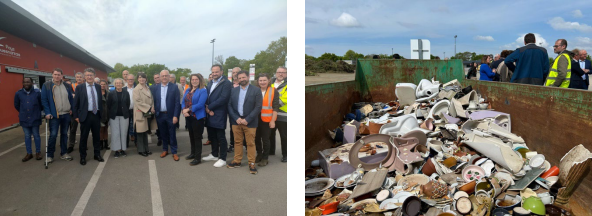
Visit to the Kerambris waste center in Fouesnant, Friday April 25, 2025, in the presence of Dominique Mignon, president of Ecomaison; Roger Le Goff, mayor of Fouesnant and president of the CCPF (Communauté de Communes du Pays Fouesnantais); Graziella Melchior, Member of Parliament for Finistère; Michel Canévet, Senator for Finistère; Annaïg Le Meur, Member of Parliament for Finistère (1ʳᵉ constituency); Franck Ysnél, Director General of Services for the CCPF; Vincent Primas, President of Cerimport Industries.
"Until now,
Roger Le Goff, President of the Pays Fouesnantais Community of Communes
ceramic products have represented a cost for our constituents, whether disposed of in household waste or in the rubble bin. By deploying
separate collection of these objects, in partnership with eco-organizations,
ceramics will no longer be a burden but a resource for our territory in
every sense of the word."
A new industrial challenge
Four eco-organizations - Citeo, Ecomaison, Ecominéro and Léko - responsible for the re-use and recycling of household products, packaging and building materials, have taken the initiative of testing separate collection of ceramic materials, with a view to developing innovative outlets.
The priority objective is not only to increase the resources available to those involved in reuse, but also to diversify the uses of recycled ceramics into new applications, such as transformation into powders with a high mineral content that are useful in a variety of sectors.
"The challenges of the circular economy are driving us to test, deploy and industrialize
Dominique Mignon, President Ecomaison
new recycling channels to enable us to save our resources.
Initiating work to set up a collection, reuse and
recycling channel for ceramic materials is a collective project that must mobilize
industries, territories and their inhabitants."
Ecomaison is the state-approved eco-organization for the sorting, collection, reuse and recycling of household objects and materials: furniture, bedding, decorative textiles, building products and building materials, DIY and garden items, toys.
By 2023, Ecomaison had collected 1.6 million tons of household and building objects and materials, 97% of which were recycled (reuse, recycling, energy recovery). Before its creation, 55% of furniture was landfilled, but Ecomaison's progress and innovations have made the eco-organization a benchmark player in the Circular Economy.