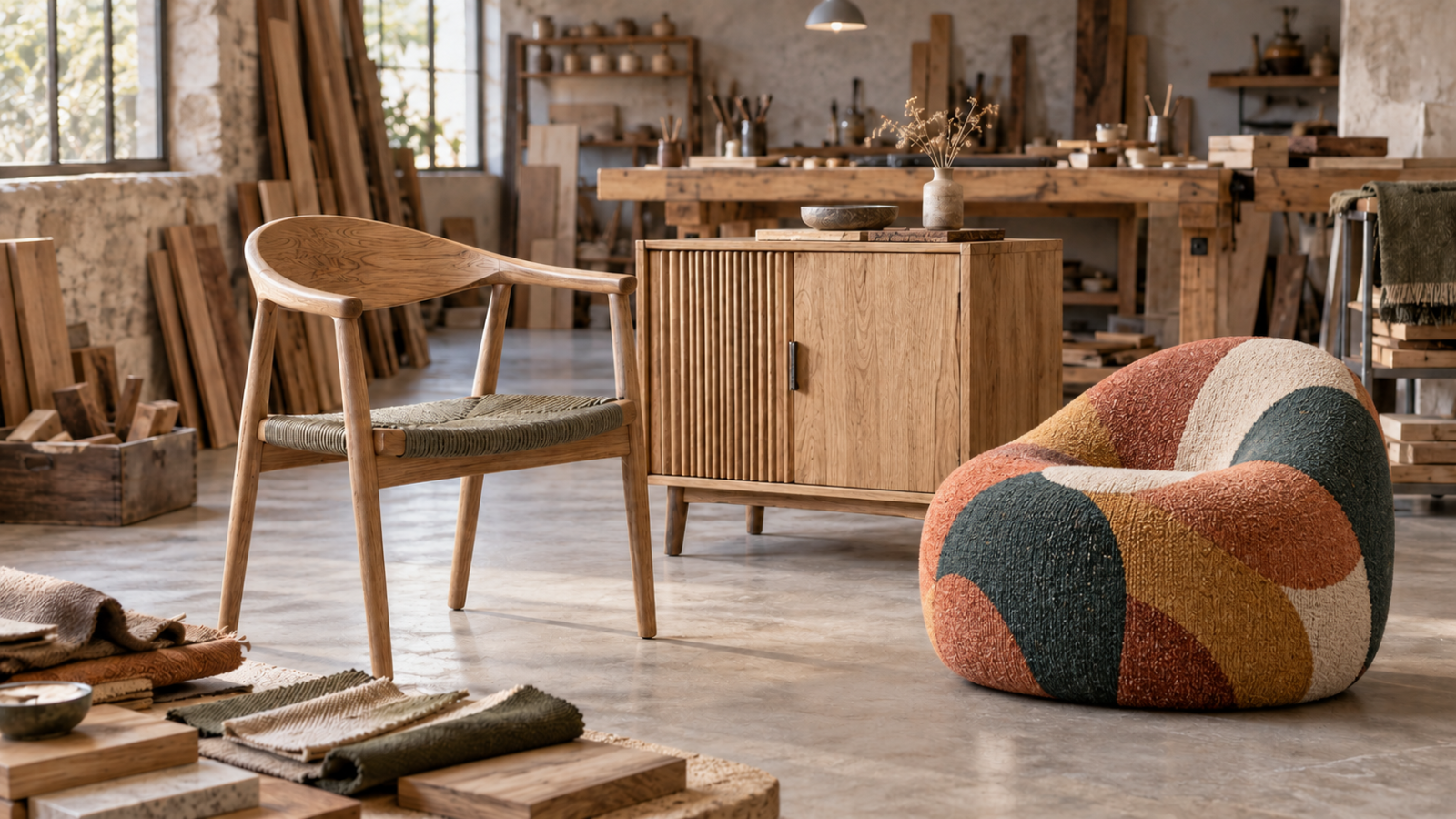
How can furniture artisans be enabled to meet the requirements of the AGEC law while taking their professional realities into account? UNAMA, Ecomaison, and the FCBA Technology Institute have jointly developed a prevention and eco-design plan (PPE) tailored to the production of one-of-a-kind pieces or small batches.
The Prevention and Eco-Design Plan (PPE) formalizes the actions a company plans to take to reduce the use of non-renewable resources, promote the use of recycled materials, and improve the recyclability of its products.
The Essentials
- The AGEC Act requires manufacturers, distributors, and importers of furniture to develop a prevention and eco-design plan.
- UNAMA, Ecomaison, and the FCBA have jointly developed a PPE tailored to the specific needs of small craft businesses.
- The initiative aims to gradually integrate eco-design into practices and to promote artisanal skills.
Why should the PPE be adapted to the realities of small business owners?
The Anti-Waste Law for a Circular Economy (AGEC) requires manufacturers, distributors, and importers of furniture to develop a prevention and eco-design plan (PPE). Its objectives? To reduce the use of non-renewable resources, increase the use of recycled materials, and improve the recyclability of products.
For small craft businesses, which primarily produce one-of-a-kind items or small batches, these regulations are seen as complex and out of touch with their reality. As a result, they are hoping for simplifications and adjustments that take their specific obligations into account, so that they can effectively implement the process.
How was the PPE co-constructed by UNAMA, Ecomaison, CODIFAB and FCBA?
To adapt the approach to the realities of craft businesses, a PPE (Professional Practice Project) was developed in partnership with UNAMA (National Union of Craft Trades in Furniture), Ecomaison, and the FCBA technological institute. Its development also involved representatives from the French Cabinetmakers' Association (AEF) and the French Upholsterers' Association (ATF). This work was financially supported by CODIFAB, the French Professional Committee for the Development of Furniture and Wood Industries.
Tailored to the specific requirements of one-off or small-batch manufacturing, this plan also offers support aligned with eco-design commitments.
The FCBA and UNAMA's partners will ensure ongoing monitoring of the entire PPE cycle.
The creation of this EPP is expected to transform a regulatory requirement into an opportunity for growth, a driver of innovation, and a means of promoting artisanal expertise. It also enables the companies involved to integrate eco-design into their daily operations in a practical and gradual manner—without disrupting their operations.

The PPE Presented at the Furniture Crafts Fair
The work on this PPE was presented at the Furniture Crafts Conference, which took place in Nantes in June 2026.
Led by Éric Jovis, the UNAMA project coordinator, a workshop brought together several people involved in the initiative: Vincent du Granrut, head of the Furniture sector at Ecomaison; Jean-Marc Barbier, a consultant in eco-design for home materials and products; Patrick Perier, director of the AME (Living Space Design) division at FCBA; and representatives from the certification programs.
Eco-design in Support of Artisanal Skills
Through this PPE, the artisanal furniture industry demonstrates thatthe circular economy and traditional craftsmanship can go hand in hand, while eco-design—tailored to the sector’s specific realities—serves as a catalyst for changing practices and elevating the status of the trades.