Ecomaison is a partner of the Lab de l'Ameublement Français and its applied research program on tomorrow's housing and living environment. Odile Duchenne, Lab coordinator, takes a look back at the latest editions of the program.
What is the Lab de l'Ameublement Français?
It is a laboratory for ideas and innovation in uses and lifestyles, whose mission is to decipher societal developments that have an impact on the Furniture industry. Domocité, an applied research program launched by Ameublement français in 2016, is now integrated into the Lab de l'Ameublement français, which aims to pilot projects concerning all markets: Home, Work, City and Hospitality. The members of Ameublement français, the vast majority of which are SMEs and VSEs, focus on the "D" side of R&D, but have neither the time nor the in-house resources to pilot the "R" side.
"L'Ameublement Français has decided to support SMEs and VSEs in applied research and in deciphering societal changes, to help them initiate the necessary transitions."
Odile Duchenne, Lab pilot.
How is a research program launched?
For programs designed to imagine the furniture of tomorrow, by meeting the challenges of innovation and social and environmental responsibility, the methodology is as follows:
- At the end of each program, industry players - furniture manufacturers, panel makers, equipment suppliers, fitters, publishers, distributors, designers and interior architects - are invited to identify the issues they wish to decipher and analyze, and then to define the theme to be addressed by the group taking part in the following year's program.
- Once the year's theme has been chosen, the 1st step is to get participants thinking about it during an initial immersion workshop, drawing on the expertise and studies of our partners, Ecomaison, FCBA and Le French Design.
- The co-construction and development workshops, run using a collaborative and iterative method, bring together all the multi-disciplinary players to imagine, develop and build together, with the help of designers, new uses and new furniture and service concepts.
For the past two years, you've been working on the circular economy. Why this choice?
- Consumers are increasingly sensitive to the issue of protecting the planet and decarbonizing French society, and are ready to embrace more responsible offers.
- Two examples from the Actineo 2025 Quality of Life at Work Barometer*: given the choice, 66% of office workers would prefer second-hand furniture, even if it is disparate.
- In the same barometer, 1/3 of Gen Z would like their company to systematically repair equipment, including furniture, to use bio-sourced or recycled materials for workspace design, and they would like to systematically use recycled or second-hand furniture in their company.
- Secondly, the circular economy is at the heart of the French Furnishings 2022/2027 sectoral project, which is committed to being a positive-impact sector.
- In 2023, we have been thinking about extending the useful life of furniture, and have come up with usage scenarios, concepts and services, taking into account eco-design, second-life furniture and a repair platform service.
- In 2024, in response to the question "How can we optimize resource management throughout the furniture life cycle? ", we came up with solutions aiming for 100% recycled and 100% recyclable, using raw, organic or reused materials, sometimes with a low-tech design to limit dependence on appliances and programmed obsolescence, not forgetting a focus on the design, manufacturing and end-of-life phases of products. These are just some of the issues we've tackled. Ecomaison gives us plenty of food for thought.
* Actineo 2025 Quality of Working Life Barometer. Survey administered by Sociovision, part of the Ifop group, in December 2024 and January 2025, among 1,500 people working mainly in offices.
Can you give some examples of applications resulting from this work?
In 2023, to extend the useful life of furniture, three furniture concepts have emerged:
- "Rallonge", outdoor furniture, evolving over time, thanks to bases that the consumer would keep for the rest of his or her life. Only the table tops would change according to need. The Collectif had imagined a tabletop exchange service, managed by a professional, or an exchange service between consumers.
- "Jusqu'à 7 vies"(Up to 7 lives) is a kitchen whose units are attached to a self-supporting metal structure, which doesn't damage the wall and can be taken with you when you move.
- "Le buffet à la coupe" is a clever reconfiguration of old furniture, from which other, more modern, small pieces are designed.
In 2024, to optimize resource management, we have come up with 3 concepts:
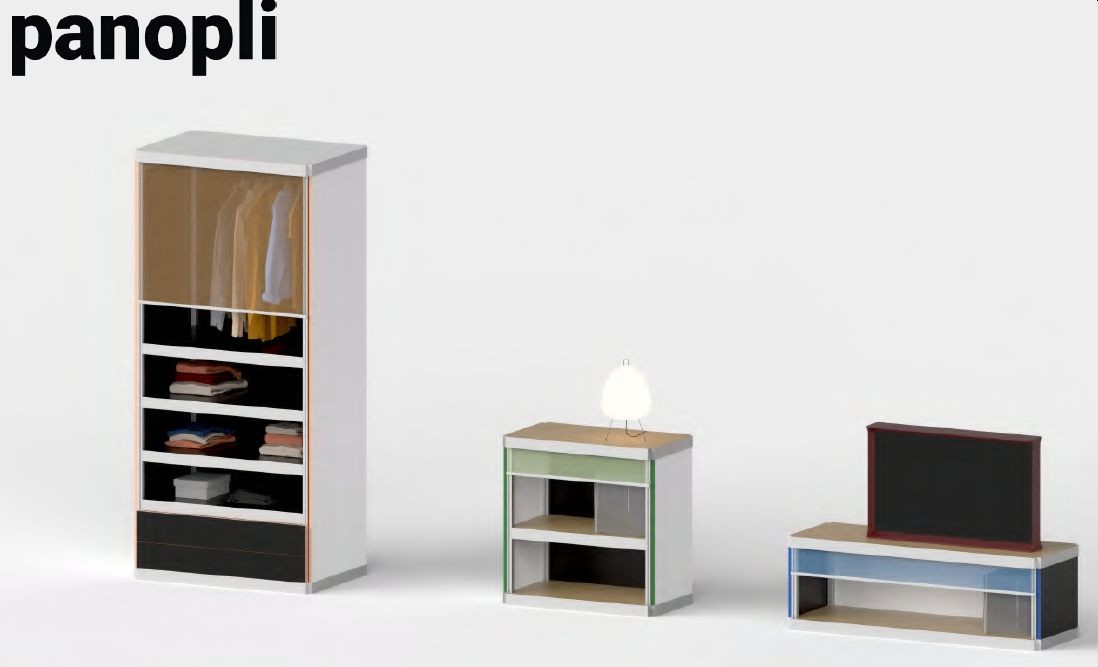
- "Pano and Panopli. The former is a sourcing service for panels made from recycled materials, and the latter is a modular storage system that can be customized and configured using recycled panels and bio-sourced materials.
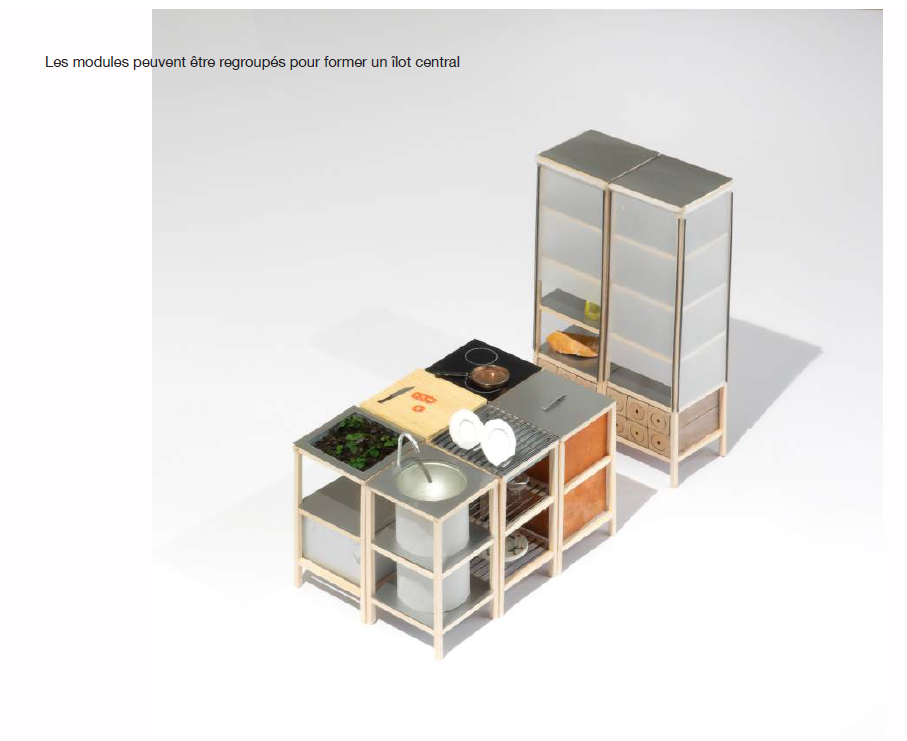
- "Modulow, the frugal kitchen, is made up of independent standard modules, without panels or drawers to use less material, that can be moved and modulated, in mono-materials with no hardware, optimizing energy consumption and reducing waste, thanks to devices inspired by natural principles (evaporative cooling, low-temperature cooking, gray water recovery, waste reuse).
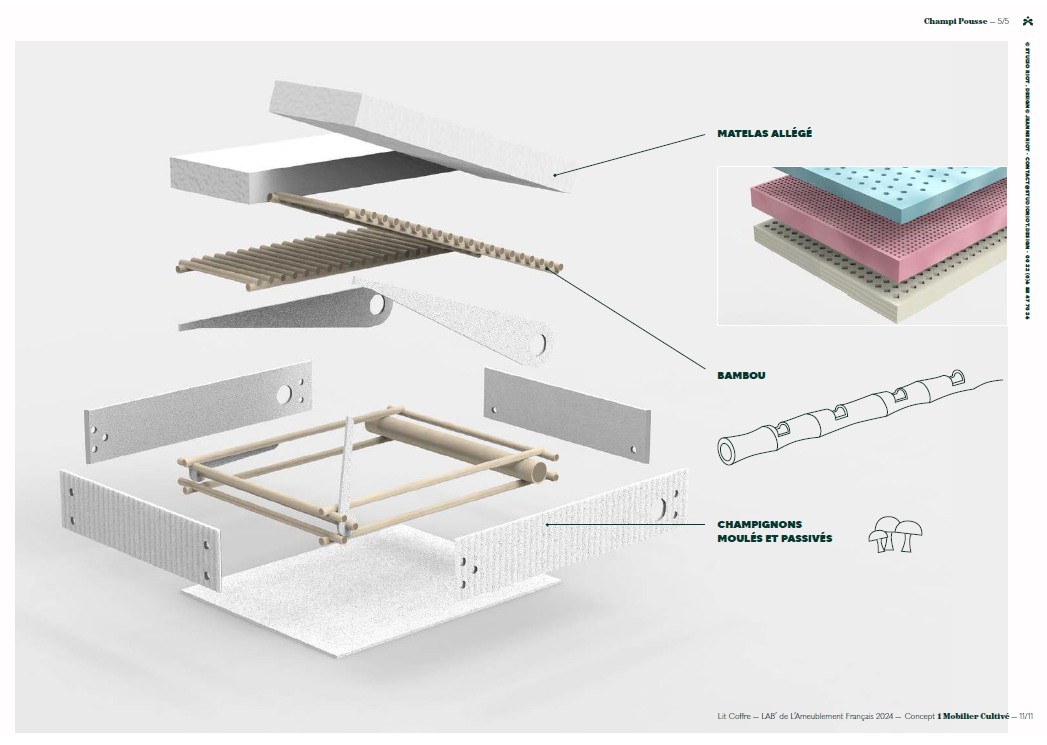
- Recycled and recyclable "bed-coffers" aiming to integrate 100% recycled or biosourced materials and a 100% recyclability rate; a bed-coffer with a 100% raw wood structure made from coppice wood or 100% organic and compostable bamboo and mycelium...
As these research programs are collective, they are not intended to lead to prototypes and publishing. However, it goes without saying that if a manufacturer wishes to continue discussions with the designer who came up with a concept as part of this program, we would be delighted to do so, as this would bear witness to the relevance of the work carried out. The aim of these programs is to provide companies with food for thought, and if they wish to take advantage of them, so much the better!
"Through the Lab de l'Ameublement, we can make the circular economy part of a research dynamic for the entire industry, and take part in thinking about tomorrow's uses."
Vincent du Granrut, Furniture Sector Manager
A professional organization that brings together 380 French companies involved in the manufacture of furnishings and furnishing of living spaces.
3 main missions :
- facilitate the conquest of national and international markets by its members,
- encourage innovation and know-how,
- commit to a virtuous, sustainable industry.