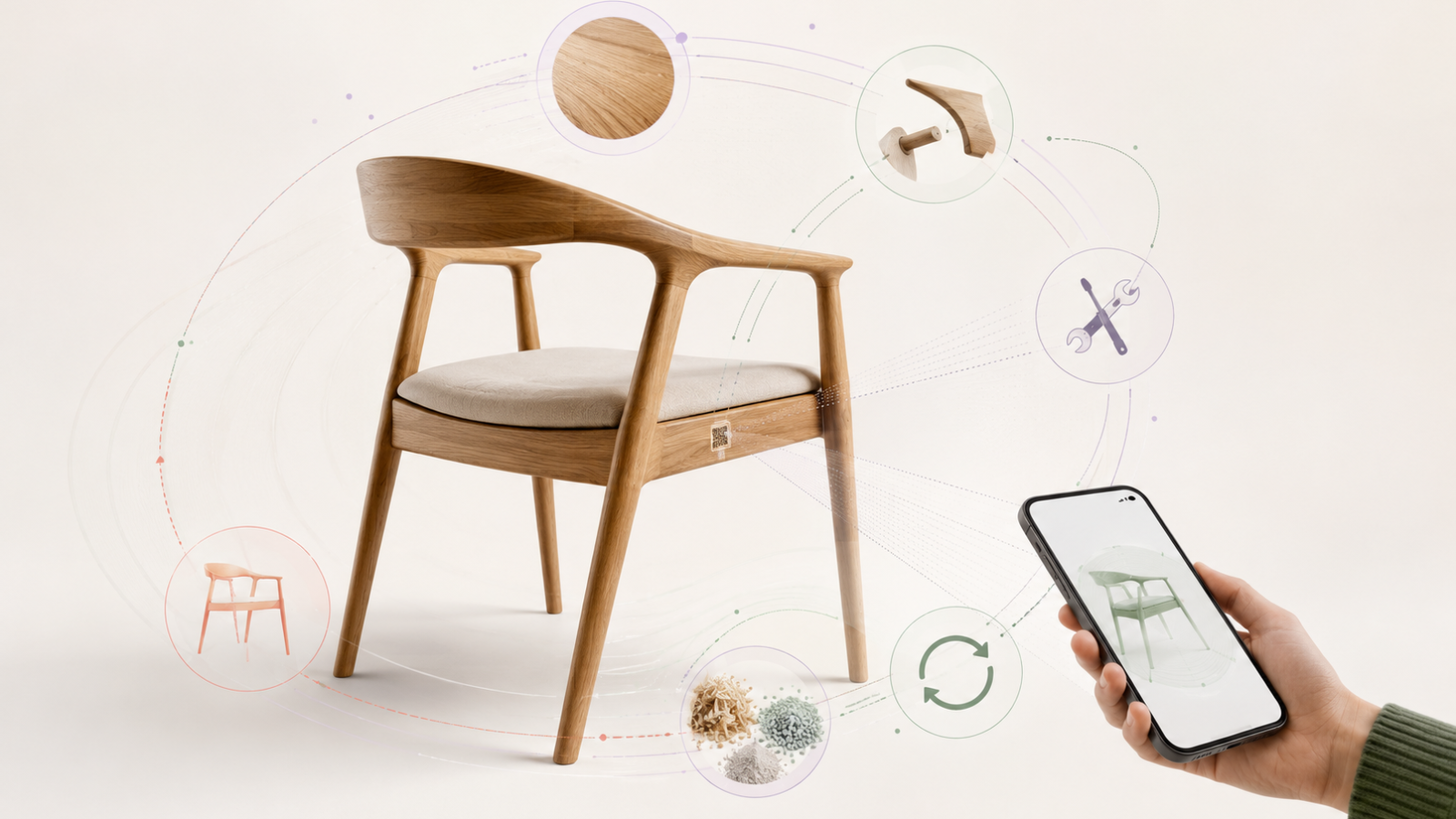
The European Regulation on Eco-–As part of its sustainable product design initiative, the company is gradually introducing the Digital Product Passport (DPP). This future digital record is intended to enable the sharing of reliable information throughout a product’s lifecycle. While the details of its implementation are still being worked out, Ecomaison is analyzing this new tool and preparing its ecosystem for its rollout.
The Essentials
- The DPP will collect information on the composition, manufacturing, characteristics, and end-of-life of products.
- Its rollout will be phased and will specify, for each product category, the required data and the conditions for access.
- Ecomaison hopes to turn this new requirement into a useful tool for eco-design, repair, reuse, and recycling.
What is the Digital Product Passport?
The digital product passport is similar to a digital ID card. Depending on the product category, it will be linked to each product.
It will include not only data specific to the product model—such as materials and substances used, manufacturing processes, technical specifications, compliance information, and details relevant to repair and end-of-life management —but also data related to events throughout the life cycle of each individual product, such as the date of manufacture, date of sale, any repairs, reuse, and so on. The specific content will be defined by the implementing regulations specific to each product category.
This information will be accessible via an identification label affixed to the product, its packaging, or an accompanying document. It will likely take the form of a QR code.
The DPP will thus track each product throughout its entire life cycle. By facilitating the sharing and updating of relevant information, it can help improve the product’s traceability and circularity.
A Common Framework at the European Level
The DPP is introduced by the European regulation on the eco-design of sustainable products, known as the ESPR. This regulation, which took effect in July 2024, establishes a common framework for improving the sustainability and circularity of products placed on the European market.
The digital passport serves several purposes: to harmonize practices, improve traceability, facilitate compliance checks, and enable stakeholders to access the information they need.
The system must be interoperable at the European level. Data will remain accessible according to differentiated access rights, tailored to users’ profiles and the intended use.

“The DPP symbolizes the commitment to using a single tool across Europe in order to align practices and facilitate the transfer of information between the various links in the value chain,” explains Laure Bisson, head of the Materials and Substances Innovation Division at Ecomaison.
Share information throughout the entire lifecycle
From manufacturing to end of life, a product can undergo many changes. Each stakeholder needs specific information to take effective action.
A repair technician, for example, might look up the specifications of a part. Someone in the reuse industry will need to know the product’s history or condition. A recycler will need to be able to identify the materials and substances present in order to choose the appropriate treatment.
The DPP is therefore designed to facilitate the flow of information among material producers, manufacturers, distributors, users, repairers, reuse operators, and recyclers. Certain data may also be made available to consumers and regulatory authorities.
Its implementation will be phased in. Delegated acts—implementing regulations adopted by product category—will specify, among other things:
- the products in question and the implementation schedule;
- the information to be included;
- the selected level of identification: model, lot, or individual product;
- the responsibilities of each stakeholder;
- the procedures for storing, updating, and accessing data.
Turning a Regulatory Requirement into a Useful Tool
Involved in the various stages of the product life cycle, Ecomaison has expertise in products, materials, and repair, reuse, and recycling channels.
This expertise can help enrich the DPP’s useful data and make it easier for various stakeholders to use that data. A key challenge will be to better direct end-of-life products toward repair, reuse, or the appropriate recycling stream.
To become a truly effective tool for cooperation, the DPP must be based on reliable, accessible, and genuinely useful information. It will also be necessary to clearly define who creates, verifies, and updates each piece of data.
“While the DPP certainly poses a challenge, it could help improve the circularity of products and even reduce their environmental impacts,” notes Benoît Godon, Head of Eco-Design and Sustainability at Ecomaison.

Ecomaison is preparing its ecosystem
In preparation for the rollout of the digital product passport, Ecomaison is inviting members of the Circular Strategy Club to participate in working groups starting in the fall of 2026.
These discussions will help identify companies’ needs, share the results of initial pilot projects, and collectively explore potential uses for this DPP beyond mere data collection. The goal: not to simply comply with this new requirement, but to use it as a tool to promote product circularity.